
How To Dislodge Food Stuck In The Esophagus: What Actually Helps?
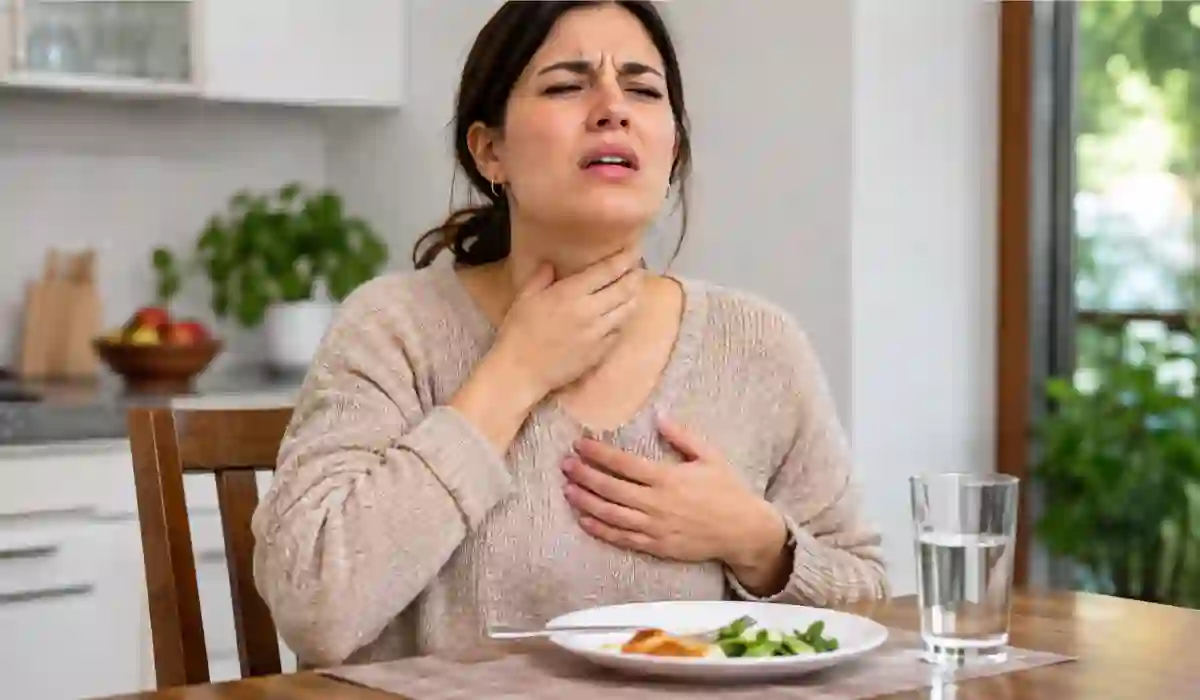
Food impaction is food stuck in the esophagus, but you can still breathe and speak. It can happen accidentally or due to esophageal conditions. If it happens, take a few sips of water to clear the blockage; if it doesn’t clear, or if you have pain, drooling, vomiting, or trouble breathing, seek emergency medical care.
Do not attempt to induce vomiting or push the food down with more solid food. If you have recurrent impaction, then it could be a signal of esophageal narrowing, eosinophilic esophagitis, or another related condition that warrants medical evaluation.
In this guide, you will learn how to dislodge food stuck in the esophagus, what happens during food bolus obstruction, its causes, symptoms of food bolus obstruction, and when you should seek emergency medical help.
What Happens When Food Gets Stuck In The Esophagus?
Swallowing is a complex process involving around 50 pairs of muscles and many nerves that coordinate to move food from your mouth, through the throat and esophagus, into the stomach. But it’s not uncommon for something to go wrong during this process, and sometimes, food can get stuck in the esophagus.
Food stuck in throat when swallowing can block the passage to the stomach and cause increased chest pressure, pain, drooling, and regurgitation. However, your breathing won’t be affected because the food has already cleared your windpipe, but you may still cough or gag.
What Causes Food to Get Stuck in the Esophagus?
The muscles involved in swallowing prevent food from becoming stuck in the throat. Food is prepared to be swallowed by chewing and mixing it with saliva, converting it into a moistened bolus. Then the tongue pushes the food to the back of your throat, where your esophagus (foodpipe) and windpipe are located. The windpipe conveniently closes during this phase, and your breathing pauses, allowing food to be swallowed and preventing it from entering the airway. The food goes into the esophagus and travels down into your stomach.
However, sometimes food stuck in the esophagus creates an uncomfortable sensation in the throat or chest; other times, the epiglottis, the elastic cartilage that protects your airway during swallowing, does not close properly, resulting in choking. Both of these instances can cause pain and discomfort, but a blocked windpipe can be a medical emergency.
The most common causes of food stuck in throat when swallowing are:
Physical Blockage or Narrowing: A large or dry piece of food gets lodged; esophageal rings or webs; scarring or stricture from chronic acid reflux; inflammation in the esophagus; tumors; or swallowing a foreign object.
Muscle or Nerve Problems: Achalasia, when the lower esophageal sphincter does not relax; esophageal spasms; Parkinson’s disease or stroke.
Inflammation or Allergy: Eosinophilic esophagitis, which is the inflammation of the esophagus, can cause recurrent food impaction.
GERD: Repeated acidic reflux can injure the esophagus lining, leading to scarring and a narrower esophagus over time, causing difficulty swallowing.
What are the Symptoms of Food Stuck in the Esophagus
Typical symptoms of food stuck in the esophagus include:
- A feeling of something stuck in the throat, neck, or mid-chest.
- Trouble swallowing solid food, often causing pain or pressure when trying to swallow.
- Chest pain or discomfort
- Coughing, choking, wheezing, or a gurgly voice during or after swallowing, which can indicate food or saliva entering the airways.
- Nausea, repeated burping, or heartburn
How to Dislodge Food Stuck in the Esophagus
The safest approach on how to dislodge food stuck in esophagus is to stop eating, stay calm and sit upright, avoid forcing anything down the throat, and seek medical attention if it does not clear or if you cannot swallow saliva.
1. Stop Eating Immediately
Do not take another bite or try to forcefully push the food down with more solids because further swallowing can worsen the obstruction, creating discomfort and making later removal more difficult. If the food is in your esophagus, you should still be able to breathe and speak; however, if you cannot, the food may be blocking your airway.
2. Sit Upright and Avoid Lying Down
Rather than lying down, sit or stand upright because downward force can help saliva and small amounts of liquid move past the obstruction. Stay seated for at least 30 minutes after eating if you have recurrent swallowing problems. This helps reduce reflux and aspiration risk.
3. Do Not Force Liquids or Solids
Stop drinking large amounts of water, eating bread, or using other methods to force the bolus down. You may have a small amount of a carbonated drink, such as a soda or Coke, if you still swallow safely, but stop immediately if it causes pain, choking, coughing, or aspiration. Avoid reaching into the throat with fingers or a utensil to force vomiting, as this can cause injury or push the bolus deeper.
4. Seek Medical Assistance if it Doesn’t Improve
Seek urgent medical care if the stuck feeling persists, you’re unable to swallow saliva, have chest pain, drooling, vomiting, or repeated regurgitation. In this case, a clinician may need to remove the food obstructing your airway with an upper endoscopy, especially if it does not pass through or there is injury, esophageal narrowing, or other underlying swallowing problems.
5. Follow Emergency Medical Instructions
If you have difficulty breathing, cannot speak or cough forcefully, faint, or have complete airway blockage, then head to the nearest emergency room immediately. Use back blows or abdominal thrusts on those who are choking, and if the person can cough, encourage them to cough repeatedly until the dislodged food is spat out. However, do not perform abdominal thrusts on someone who can breathe and talk normally.
Can Drinking Water Help Dislodge Food Stuck in the Esophagus
Yes, you can drink water when there is a food bolus obstruction, but only if you can swallow safely and breathe normally. 3-4 big sips of water may help break down smaller food boluses, making it easier to be passed into the stomach. However, you shouldn’t keep drinking water if the food doesn’t clear easily, or if you cannot swallow saliva.
Do Home Remedies Help Remove Food Stuck in the Esophagus
Home remedies like taking a few small sips of water or a carbonated drink only work if you can breathe and swallow saliva while the food is still stuck. But there is no reliable home remedy to safely remove the food if it is truly stuck in the esophagus, and trying to force the bolus down with more water or food makes the choking worse and increases aspiration risk.
Try these dislodging methods if you can breathe normally and swallow saliva:
- Take a few small sips of water; avoid gulping large amounts
- Drink a small amount of carbonated drinks, such as soda or sparkling water, which helps break down the bolus, allowing its safe passage down the esophagus into the stomach
- Have a small piece of moist food, such as a banana, to help push the bolus down; do not force it
- Sit upright and avoid lying down if you’re choking
How Do Doctors Remove Food Stuck in the Esophagus
Usually, doctors perform an upper endoscopy (EGD) to remove food stuck in esophagus. But first, a clinician checks whether the food can safely pass into the stomach and may give medications to relax the esophagus before using a tube-like instrument to retrieve or advance the food bolus.
- The doctor asks about your symptoms, checks whether you can breathe and swallow saliva, and may order an X-ray or CT scan to locate the obstruction by imaging.
- If your breathing is normal and the dislodgement is incomplete, the doctor may keep you under observation to see whether the food passes on its own. If it is not cleared within 24 hours, a manual removal may be necessary because there is an increased risk of esophageal injury or perforation.
- The doctor may administer a dose of glucagon through your vein to relax the lower esophageal sphincter, allowing the food to move easily into the stomach. However, this does not guarantee a result, and if it fails, an endoscopy is performed.
- During an EGD, the doctor sedates you before passing a flexible, lighted tube through your mouth into the esophagus. They inspect the area, assess for injury, and use tools such as forceps, a retrieval net, or a basket to grasp and remove the food dislodging your esophagus.
- A surgery may be required if an endoscopy cannot remove the obstruction or if there is a perforation or injury.
When Should You Seek Emergency Medical Help For Food Stuck in the Esophagus
Seek emergency medical help if food is stuck in the esophagus and you have the following symptoms:
- Unable to breathe, speak, or cough forcefully
- Have noisy breathing, wheezing, or bluish-gray lips or face
- Inability to swallow saliva, drooling, or vomiting repeatedly
- Shortness of breath, chest pain, fainting, or severe distress
- Vomiting blood
How to Prevent Food From Getting Stuck in the Esophagus
Follow these practical steps to prevent food obstructions from happening in the esophagus or windpipe:
- Sit upright at a 90-degree angle while eating, and remain in that position for at least 10 minutes after eating
- Eat smaller mouthfuls of food; chew slowly and thoroughly before swallowing and taking the next bite
- Take small, moist, bite-sized portions; add gravy or sauce to loosen dry foods
- Avoid eating when tired, stressed, distressed, or intoxicated
- Limit talking while eating
- Be mindful of dry, sticky, or fibrous foods, which can clump together when mixed with saliva, risking a throat blockage
Conclusion: How to Dislodge Food Stuck in Esophagus
Food impaction can be uncomfortable and alarming, but learning how to dislodge food stuck in the esophagus can ensure your as well as other’s safety and well-being. If you can breathe and swallow saliva, taking a few small sips of water or carbonated drinks may help clear minor blockages, but never force solids, gulp large amounts of liquid, or induce vomiting because they can increase the risk of aspiration or esophageal injury.
If food remains lodged for more than 10 minutes, or if you experience chest pain, drooling, or severe distress, seek immediate medical care. If you or a loved one faces persistent swallowing difficulties, consult a doctor for a proper evaluation to diagnose the underlying cause and protect your long-term health.
FAQs
1. Can throwing up dislodge food stuck in esophagus?
Yes, spontaneous vomiting can sometimes push stuck food back up. However, forcing yourself to throw up is risky and not recommended by doctors.
2. Will food stuck in my esophagus eventually go down?
Sometimes, food stuck in your esophagus may go down on its own, but it can also stay trapped or cause serious complications if it does not pass quickly.
3. What dissolves food stuck in esophagus?
Carbonated beverages like cola or sparkling water, effervescent medications like Alka-Seltzer, or a mixture of baking soda and water can help break down and dislodge food stuck in the esophagus.
4. How do doctors remove food stuck in esophagus?
Doctors remove food stuck in the esophagus primarily by performing an urgent upper endoscopy. If the complication is severe, surgery may be necessary.
5. How long can food stay in your esophagus?
Usually, food takes only about 4-8 seconds to pass through your esophagus and reach the stomach.